How does one communicate? Do they choose their words carefully, deliberate so as to avoid either misunderstanding or mistranslation? How then, without speaking, does one share with another being that dawning awareness that is itself experiential in nature—coming from a place that is, in a sense, both pre-literal and pre-egoic? I speak of the ineffable, that which is neither contained nor conveyed by words alone. You won’t find such answers in these frail words of mine—but, if fortunate, you might just catch a glimpse in the subtle smiling face of an arhat.
With our recent class visit to the Royal Ontario Museum (ROM) I found myself both awed and intrigued by the many artifacts on display…misplaced and out-of-time in comparison to their respective beginnings, both curious and diverse. From Nestorian crosses, to Gandharan Buddhas, to a Medieval Chinese stela (describing an example of communal, donation-based fundraising—a forerunner to today’s modern ‘crowdsource’ funding model). Accompanying each object was a short description, curtly offering their curation in some abbreviated form. Such descriptions, however, could neither contain nor convey the reality of the artifacts themselves—similar to how a map cannot in fullness describe the reality of a terrain.
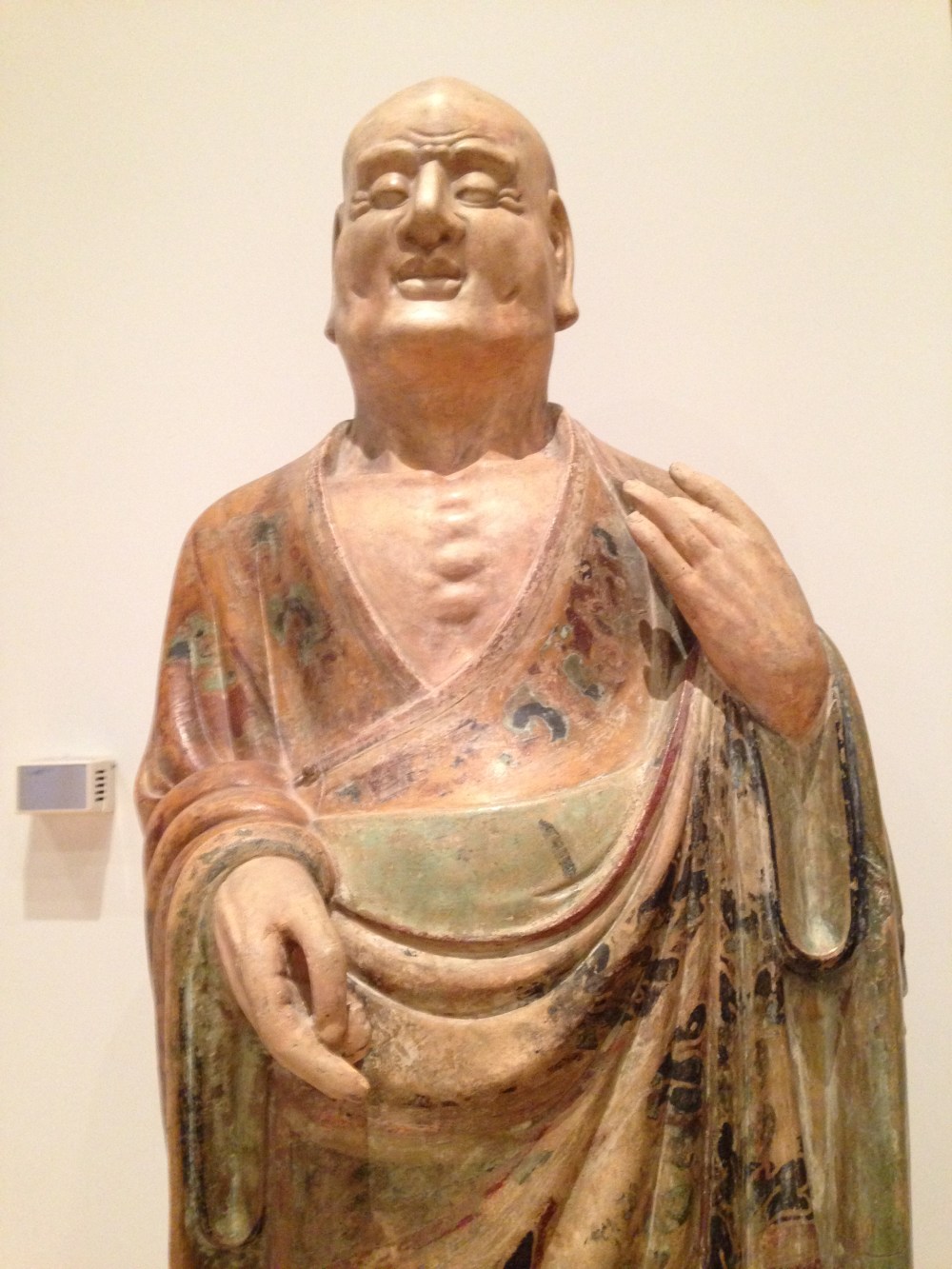
In particular, I found myself drawn to the polychrome marble statue of Mahākāśyapa, or Kashyapa, (Shanxi Province, 8th century, Tang Dynasty), flanking the left-hand side of Gautama Buddha. Mahākāśyapa is an intriguing figure, being one of the Buddha’s key disciples, sometimes referred to as the ‘father of the sangha’. Some accounts ascribe miraculous powers or siddhis to Mahākāśyapa. The Chinese Chan and Japanese Zen traditions also see Mahākāśyapa as the first successor or dharma heir of Gautama Buddha. According to the Flower Sermon of these traditions, Mahākāśyapa subtly smiles upon witnessing Gautama Buddha silently lifting up of a white lotus flower in a moment of wordless teaching. At that moment of sparsa, or contact, it is said that the Buddha recognized a moment of shared understanding or meeting of minds—like two arrows meeting in midair. It is this same subtle smile that I see on the face of see Mahākāśyapa in the Bishop White Gallery of Chinese Temple Art at the ROM.
It is interesting to note that the Buddha and Bodhisattva images depicted clearly reflect the artistic styles and cultural norms of the periods in which they were created. In the same way that one might easily find a ‘Korean Jesus’ in a modern Korean Protestant church, one can see clear regional and temporal changes in the faces and clothing of our Buddha and Bodhisattva images as one moves from Gandhara to Dunhuang—old flesh traded for new as the Buddha image is translated for a new audience. If one ascribes to the philosophy of inherent buddha nature, then it is important that we be able to see ourselves, our lives, reflected in the ideal image of an awakened being.
 Takuhatsu