What’s Old is New

What’s old is new…a sentiment aptly alluded to by Finbarr Barry Flood in his article Between Cult and Culture: Bamiyan, Islamic Iconoclasm, and the Museum. In this article, while Flood does detail some historical instances of Islamic iconoclasm, or iconoclastic “moments”, he also takes great effort to highlight how many of the “rhetorical claims of image destruction have often been taken at face value, even when not borne out by archeological or art historical evidence”. Flood further highlights how it is not within Qur’anic scripture but within the Hadith that one may find the basis of Islamic opposition to figuration–primarily in “not usurping divine creative powers” or falling into the trap of idolatry. As such, figural imagery has found mixed acceptance within Islamic circles, who’ve tended to favour epigraphic or vegetal ornamentation, often referred to as aniconic, given the absence of representation of either sentient beings or gods. An Abrahamic faith, the God of Islam (Allah) cannot be represented or contained within figurative imagery or graven idol. Old arguments allege that an any idol or icon may be confused for something more than its materials and, subsequently, worshiped. The inspiring awestruck moment when one encounters deep art indeed has a transformative quality not unlike one’s encounter with sacred space or ritual. The only means of rendering such figural images as impotent, Flood argues, is to either recontextualize them or to decapitate them, “so that they become inanimate, that is, devoid of a soul“. Likewise, mutilation or defacing of an image appears to be an adequate substitute for decapitation. Flood also makes it clear that even those elements symbolic of the divine, such as the Christian cross or the Muslim minbar, might be seen viable targets for desecration or destruction. The crux here, no pun intended, seems to be the prohibition against confusing any object or representation with the divine–that is, prohibition against idolatry. Destruction did not always mean obliteration, often serving as code within Medieval texts for the “transformation” of a site’s previous architecture, monuments, or statuary–with eyes scratched out or heads removed. It was, therefore, “essential to render the image powerless, to remove from them their consecrated contexts”. This point, from Andre Wink, highlights the danger associated with images that might serve as vessel for either “quasimagical powers” or “evil or malevolent spirits”. The Bamiyan Buddhas and their contemporaries no doubt suffered from iconoclastic “moments” well before the modern era. It should be noted that iconoclastic impulses are not the strict providence of Islam and that many works formerly imbued with deep religious significance has been recontextualized and reconfigured as art–objects for sale, divorced from their ritual past. This view, common when encountering ancient traditions no longer extant–such as the mystery cults of ancient Greece, Rome, or the Near Middle East–sees such figural or cultic images as deanimated not by way of defacement or decapitation but by way of the divide encountered when time and shifting belief have rendered such icons impotent of their former ritual significance. The question begs itself: “When does an object lose its religious significance?” A further question might be: “In the face of action clearly in violation of customary law, international law, and the laws of armed conflict–whereby cultural icons are willfully destroyed as spectacle–how do we best protect our shared cultural history?” One need only look to the bombing of Monte Cassino, the former home of the Benedictine Order, during World War II to see how dramatically current events in the modern world are risking the irretrievable loss of religious heritage. Moving forward one might look at the bombing of Bagdad in 2003, and the looting of the Bagdad Museum. Wholesale destruction of icons and historical treasures need not be acts of iconoclasm or be motivated by harmful religious intent–they are often the result of careless expedience and a willful disregard of accepted law.
The ‘Outsiders’

If one examines the distribution of the over 20 million  Muslims living in China one will see a clear pattern of distribution reflected by the proverb “widely scattered but locally concentrated”. Playing a vital role in trade, often as merchants operating via both sea routes and the overland Silk Road, early Muslim inhabitants of China, though often far flung and widely scattered, were nonetheless typically concentrated into local somewhat autonomous quarters within Chinese cities. Within but also without, given that these distinct Muslim quarters were typically found outside of the main city walls–later appendices to a developed city grid plan. An afterthought, if you will, with protective walls added later only in light of the protection of resources and trade relations. This depiction of the evolution of early Muslim Quarters within China, so clearly described by Piper Gaubatz, is further examined in the light of modernity by Maris Boyd Gillette in the work “Between Mecca and Beijing…”. In this work, Gillette discusses Xi’an’s Muslim District or Hui Quarter and some of the issues faced by the modern Hui people. To begin there’s the disparity of resources allocated to education within the Hui Quarter and the exceedingly low level of matriculation and continuing on to higher education evidenced among the Hui population of Xi’an (in comparison to their Han counterparts). Some prevalent narratives (or stereotypes) might see distinct cultural differences (i.e. “low cultural quality”), poor parental supervision of homework or  study habits, or concern with ‘petty’ family business as causal factors.  Gillette, however, provides some evidence to suggest that it is, rather, a lack of institutions (e.g. ‘key’ schools), a lack of proper resource allocation or support by government officials (especially with the closing of schools during the cultural revolution period) that has had the greatest influence. Further, there appears to be an innate Han chauvenism, a “classification of China’s non-Han races as more ‘backward’ and less modern than the Han”. To quote Gillette:               “In the eyes of many Han officials with whom I spoke, however, the ‘low cultural quality’ was a racial trait, as characteristic of the Hui as their success at business.”                         Other terms applied to the Hui people include: “feudal”, ” backward”, “superstitious”, “sensitive” (mingan), and “troublesome” (naoshi). In this case, by categorizing and ranking culture in relation to race, it might be argued that a state sanctioned ideology of difference and discrimination was established, marking those non-Han as ‘Other’ or ‘Outsider’ marred by “customs and habits”–part of larger society, but still marginalized or segregated. This is ironic, in that this is the same sort of phenomenon that occurred in the West, leading to the establishment of numerous Han Quarters or, as we might call them, “Chinatowns.”


Shifting sands and support

The modern day separation of church and state in the West is very much the exception to a greater historical trend whereby, more often than not, secular power had worked to privilege a particular faith tradition over others or to persecute those groups of differing faith. In reading the chapter “Ecumenical Mischief” by Richard Foltz, one can clearly see examples of such in the case of the Naiman leader Kuchluk–who “launched a full-scale persecution of the of the local Muslim community, forbidding the ritual prayer (salat) and commanding Muslims to convert to Christianity or Buddhism” (Foltz, p.106)–or in the case of Berke–who “sanctioned the slaughter of Samarkand’s Christians while they wee assembled in church” (Foltz, p.116). Similarly, edicts against practices such a halal butchery, bathing in running water, or circumcision clearly made life difficult for many a Muslim or Jew–who were at times forces to practice their respective faiths in secret. It was perhaps more the secrecy of their subjects that offended certain rulers, ever fearful of plotting against their persons or houses, than the doctrines of certain ‘out’ faiths motivated state-sponsored action against them. The historical Silk Road served to provide a vast nexus of meeting places for the cross-pollination of cultures and ideas–including those regarding religious doctrine and practices. Tolerance, while never the full norm, was often valued with a sort of ‘general openness’, setting the stage for both individuals and individual faiths to prove themselves valuable. As such, the dominance of any one religion or faith tradition would often prove nebulous over time, allegiances shifting like desert sands, with Islam starting to dominate the Western Silk Road and Buddhism the Eastern portion. While formal ‘interfaith dialogues’ or debates did take place under the Mongol Empire, such as the one described by Franciscan friar William of Rubruck, these moments should not be considered the norm. While praised by Muslim historian Kwand Amir for being open to “philosophical and religious debates” and for having ordered the translation into Mongolian of numerous scriptures from differing traditions, it should be noted that the famed Khubilai Khan was also responsible at one time for the suppression of Daoism and destruction of their texts in 1281CE (Foltz, pp. 117-118). Religion, when seen as a living tradition of community-based beliefs and practices, requires both space and support if it is to exist and remain both extant and relevant within a given society. In practice, many of the rulers along the Silk Road either privileged a particular religious tradition over another, denigrated a particular religious tradition, or merely pitted religious rivals against one another as a means of balancing power. While fairly multicultural and metropolitan in comparison to much of Medieval Europe at the same time in history, the historical Silk Road kingdoms of the Mongol Empire cannot be seen to be true places of pluralism with regards to religious faith.

Words without speaking

How does one communicate? Do they choose their words carefully, deliberate so as to avoid either misunderstanding or mistranslation? How then, without speaking, does one share with another being that dawning awareness that is itself experiential in nature—coming from a place that is, in a sense, both pre-literal and pre-egoic? I speak of the ineffable, that which is neither contained nor conveyed by words alone. You won’t find such answers in these frail words of mine—but, if fortunate, you might just catch a glimpse in the subtle smiling face of an arhat.

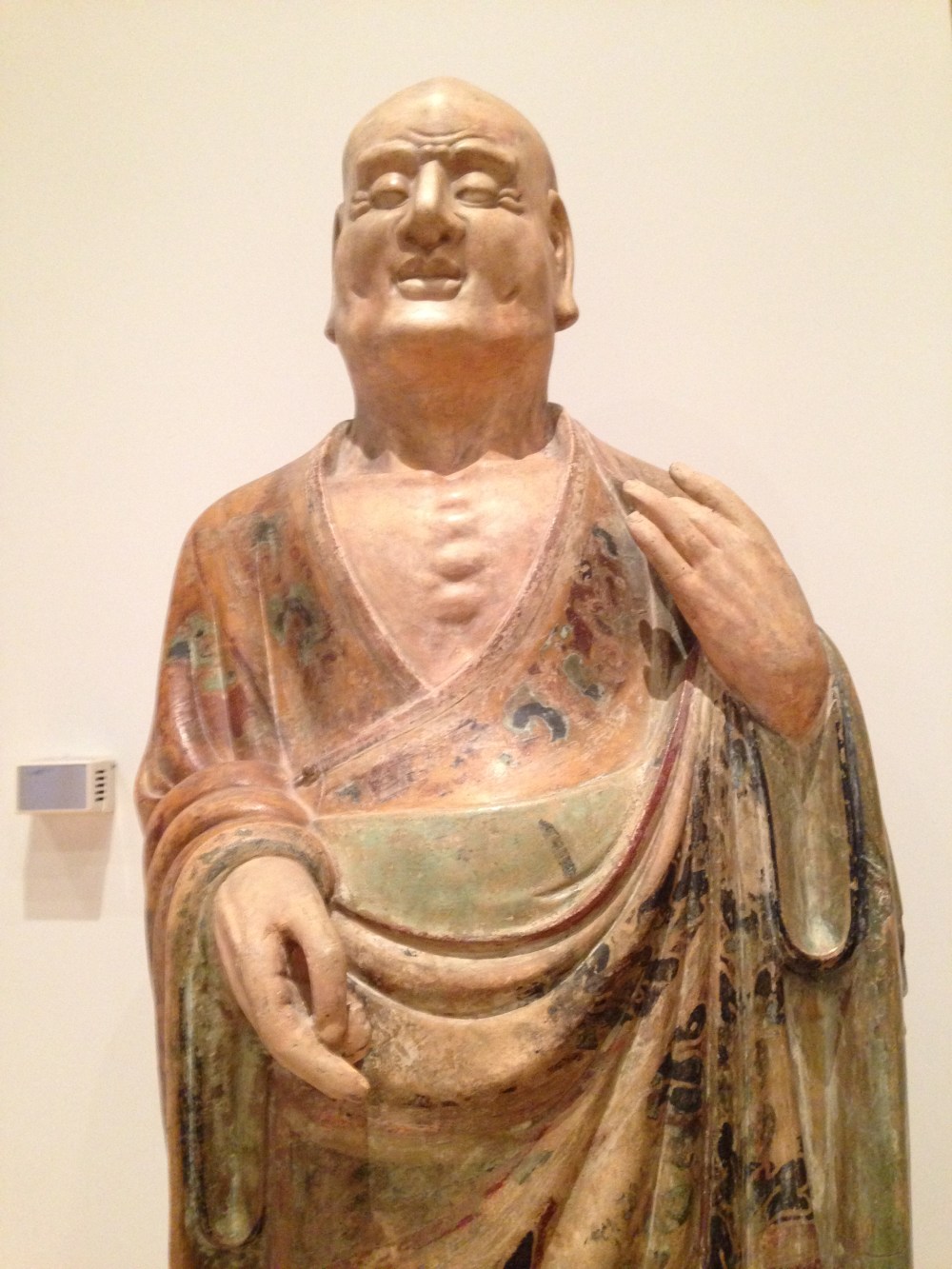
With our recent class visit to the Royal Ontario Museum (ROM) I found myself both awed and intrigued by the many artifacts on display…misplaced and out-of-time in comparison to their respective beginnings, both curious and diverse. From Nestorian crosses, to Gandharan Buddhas, to a Medieval Chinese stela (describing an example of communal, donation-based fundraising—a forerunner to today’s modern ‘crowdsource’ funding model). Accompanying each object was a short description, curtly offering their curation in some abbreviated form. Such descriptions, however, could neither contain nor convey the reality of the artifacts themselves—similar to how a map cannot in fullness describe the reality of a terrain.


Maha.jpg

In particular, I found myself drawn to the polychrome marble statue of Mahākāśyapa, or Kashyapa, (Shanxi Province, 8th century, Tang Dynasty), flanking the left-hand side of Gautama Buddha. Mahākāśyapa is an intriguing figure, being one of the Buddha’s key disciples, sometimes referred to as the ‘father of the sangha’. Some accounts ascribe miraculous powers or siddhis to Mahākāśyapa. The Chinese Chan and Japanese Zen traditions also see Mahākāśyapa as the first successor or dharma heir of Gautama Buddha. According to the Flower Sermon of these traditions, Mahākāśyapa subtly smiles upon witnessing Gautama Buddha silently lifting up of a white lotus flower in a moment of wordless teaching. At that moment of sparsa, or contact, it is said that the Buddha recognized a moment of shared understanding or meeting of minds—like two arrows meeting in midair. It is this same subtle smile that I see on the face of see Mahākāśyapa in the Bishop White Gallery of Chinese Temple Art at the ROM.

It is interesting to note that the Buddha and Bodhisattva images depicted clearly reflect the artistic styles and cultural norms of the periods in which they were created. In the same way that one might easily find a ‘Korean Jesus’ in a modern Korean Protestant church, one can see clear regional and temporal changes in the faces and clothing of our Buddha and Bodhisattva images as one moves from Gandhara to Dunhuang—old flesh traded for new as the Buddha image is translated for a new audience. If one ascribes to the philosophy of inherent buddha nature, then it is important that we be able to see ourselves, our lives, reflected in the ideal image of an awakened being.

Recreating a past long since vanished…

In recreating a past long since vanished we are, in a sense, creating whole new worlds within the mind’s eye—partly authentic in nature, and partly fashioned from the stuff of antiquarian embellishment. In his book Golden Peaches of Samarkand: A Study of T’ang Exotics, Edward H. Schafer describes both the historical fact and literary fancy of the T’ang period in Ancient China, particularly as it relates to Chinese interactions with exotic peoples and the shifting fortune of foreign commerce or trade in exotic goods. In this work Schafer, much like Richard Foltz in “A Refuge of Heretics: Nestorians and Manichaeans on the Silk Road”, highlights how contemporary pressures (political, religious, and economic) at times led to far less amicable relationships between the T’ang and their foreign guests—evidenced at one far extreme by accounts depicting the massacres of foreign merchant communities at both Yangzhou and Guangzhou (760 CE and 878-879 CE respectively). More common would be the routine interrogation of new trade envoys, or the curtailing of foreign agency by various laws or edicts—as in the case of Emperor Wuzong’s short-lived outlawing of foreign religions in 845 CE [Foltz], or the 779 CE edict compelling Uighurs living in the capital to wear their “native costume” and which “forbade them from trying to ‘lure’ Chinese women into becoming their wives or concubines [Schafer]. It was not merely foreigners themselves but foreign customs and foreign religions that were to be held suspect. In such context the foreigner’s place was seen to be distinctly separate from that of their Chinese contemporaries, with foreign merchants and envoys segregated into smaller communities with strict limits on both trade and interaction with local Chinese. In speaking of far off realms, Schafer notes that “it was readily believed that spirits and monsters waited at every turn in the mountain trail and lurked beneath every tropical wave”. More telling is Schafer’s observation that “people and goods from abroad naturally partook of this dangerous enchantment” and that, in the minds of many Chinese, “it is probable that exotic goods were still invested with the aroma of uncertain magic and perilous witchery”. Such misconceptions and romanticisms might easily fall into the category of what Western scholars would later call ‘Orientalism’. Is it any wonder then that things foreign or wondrous might be deemed as suspect? In the modern context, one can see how images of the dangerous ‘other’ have been used to mobilize a variety of xenophobic responses—ranging from the banning of particular forms of religious garb to the segregation and persecution of various minority communities. On the other side of the spectrum are accounts of Chinese fascination with foreign fashions, artistic styles, cuisines, and exotic trade goods—seen in poetic accounts of Iranian waitresses, or in the Chinese appreciation of the works of painters such as Yen Li-te or Yü-ch‘ih-i-seng. Schafer also explains that it was common for foreigners to be depicted in native costume “with their curious features emphasized”, as with a caricature. In the case of exotic tributes there exists both the official record and the literary report of wondrous items, such weird and lovely objects, Schafer describes as having “the glamour of wares that existed nowhere on land or sea…brummagem of the mind and tinsel of imagination”. Occurring in the literature of the 9th century CE, such wondrous items recall the exotic tributes of a time centuries past, now the stuff of pale memory and embellished recollection amidst a declining T’ang Empire. One might see the scholar Su-O as attempting to recreate or evoke an age long past in his 876 CE work Assorted Compilations from Tu-Yang. In their nostalgia, writers such as Su-O provide compelling accounts of “imaginary gifts, which in turn feed the imagination”. In such tales, one might argue, that which is foreign is less scapegoated than marveled at—as in the case of “magic shining beans”, “dragon horn hairpin”, or “fire-jade”. Such literature alludes to a greater depth lying beneath the veneer of mere surface appearances, wherein fantastic tribute or exotic objets d’art might offer whole worlds of adventure, whereby one might find oneself in a decided encounter with most ‘interesting times’.

Death and Taxes

Information or intelligence is critical if those in power are to be both well-informed and fully capable of enacting those policies and processes that will reflect proper governance. Perhaps nowhere in the lives of a common people is this better reflected than in those inevitable concerns regarding both ‘death and taxes’. In “The Lushan Rebellion and its Aftermath (755-960)”, Chapter 6 of her book The Open Empire: A History of China to 1600, Valerie Hansen astutely notes that the “[…] the Tang dynasty lost most of its power in 755, the year of the An Lushan rebellion”. If one follows Hansen’s line of reasoning, then one may view this period as one marked by both loss and fragmentation, whereby Emperor Xuanzong and his successors were forced to cede power away from the central authority of the Emperor and towards regional military commanders. These provincial powers became responsible for both local armies and their funding, paid not by a centralized Imperial government but by local taxes. Taxation, difficult even in the very best of times, was further compounded by a lack of tri-annual (land and population) census data which Hansen argues “wrecked the equal-field system”, in that “the government no longer maintained any records concerning the landholdings or output of any individual cultivator”. Individual taxation could no longer be representational (with tri-annual reallocations made) but, rather, simply reflected a part-share within a larger regional quota, with individual tax burdens assigned at the whim of government officials and taxes collected twice-yearly. The overall economic effect proved profound. As Hansen points out, “after the rebellion, the tax base of the empire was less than one-third of what it had been”, with far less flowing into the Imperial coffers. Defence, a matter of life and death, no doubt suffered under a divided, decentralized, and defunded China.  As an aside, one need only look to the recent controversies within our own country surrounding the temporary suspension of the long-form census or the willful purging of huge amounts of archived scientific and statistical data by the previous federal government to see how the loss of information held by a government in power can have unforeseen effects both subtle and far-reaching. One of the poems of the period, written by Bai Juyi, reflects the reality of unfair government privilege. In this poem, a palace marketing system—whereby the price of goods flowing into the palace might be set by palace eunuchs, regardless of the fair market price—is used by two officials to cheat an old charcoal-seller out of an entire cart of charcoal for a mere pittance. Again, this burden was not equally shared by all. Buddhist clergy and monasteries who were themselves tax exempt were viewed by some as posing a burden on an already strained economy—so much so that the year 845 saw an attempt by the Emperor to suppress Buddhism, by returning the clergy to the laity and in confiscating or re-purposing monastic wealth and properties. One may well view this moment as analogous to the blatant ‘cash grab’ seen with confiscation of Catholic wealth by the English monarch King Henry VIII. The indigenous Chinese conception of death was itself not free from material concern, with one’s spirit traveling to the Underworld “in one’s own body”, and enduring the physical torments of Hell. Hansen highlights a shift in Chinese Buddhist culture, whereby charitable contributions or offerings to the living Buddhist community (and not to one’s dead ancestor) that the greater merit might be accumulated towards the benefit of one’s departed kin. This proved a key alternate funding model for monastic communities.

Buddha’s Marrow: Teachings that Liberate

Transmission cannot occur without first there being contact or a meeting of minds. Such encounters may happen face-to-face—the words or gestures of a teacher acting like a well-thrown stone, finding its mark and leaving tell-tale ripples upon one’s mind-stream. Such moments of sparsa may also bring with them a deep and abiding sense of the sacred. In her work The Buddhist Holy Land author Sally Wriggins astutely comments upon the journey of Chinese monk Xuanzang who, in the 7th century CE, made the pilgrimage to India famously documented in his work Great Tang Records on the Western Regions. Both Xuanzang’s and Wriggins’ writings prove poignant, illustrating how the past can also speak to the present.

Each shrine and stupa encountered by Xuanzang would come with their own story.  One such example, located near Jetavana monastery, was said to mark the place where the Buddha had performed miraculous healings (of both a sick monk and of once blinded criminals). Another marks the place where the Buddha was said to have proved mastery over both fire and water and to have performed “an even more popular miracle…that of the Buddha multiplying himself thousands of times”. Tales of such miraculous occurrences, though quite common in later South Asian hagiographies, no doubt did much to further enhance the popularity of early Buddhism following the death (parinirvana) of the historical Buddha Shakyamuni. One might well argue that the true bones of the Buddha are not those fabled ashen relics of his burnt body but the very shrines and stupas scattered throughout Asia and the world. Similarly, it may be argued that the teachings themselves form the very marrow of the Buddha.

The sites, symbols, and stories encountered on his pilgrimage are reported to have had a profound effect upon Xuanzang, who is said to have fallen to ground and wept upon seeing the Bodhi tree at Bodh Gaya. The life of the Buddha and the transmission (and translation) of the Buddhist teachings are not abstract stories but contextual narratives, bound by the very strata of historical time and space. Sites serve to anchor stories, particularly in an ancient world where literacy was rare and artistic representation and its associated symbols often served to anchor narrative and facilitate instruction. In recalling the lighting of small oil lamps within Mahabodhi temple at Bodh Gaya or the famed statuary of Sarnath we perform a sort of mental pilgrimage alongside Xuanzang and those who followed.

As Valerie Hansen points out in her work China’s Religious Landscape, there was great concern that Buddhism within China be authentic. The historical journey by Xuanzang to obtain such Indian authenticity should be seen as less a concern involving a most harmonious path (wuwei) than one of incalculable risk and unforeseen reward. It is in this spirit that Xuanzang, following in the footsteps of Faxian, began his pilgrimage. The Buddhist religion, offered a more optimistic alternative regarding both impermanence and the afterlife–no longer a bleak, judiciary affair involving eternal imprisonment for many. It was not the mere bones of the Buddha that Xuanzang brought back with him to China but the Buddha’s very marrow—teachings that liberate.

Given time enough…

Given time enough, both desert sand and the waters beneath may shift—creating new potentials and carving novel pathways, those both visible and as yet unseen.

Judith A. Lerner, in Chapter 6 of Monks & Merchants…, identifies “trade” as the main “impetus for cross-cultural exchange” along the ancient Silk Road, dating from the 4th to 7th centuries CE. Lerner further identifies the Sogdian merchant class as lead actors in this exchange, with the Sogdian language serving as a sort of lingua franca along Silk Road stretches. So prevalent was Sogdian merchant influence that, Lerner notes, the Khotanese word sūlī (Sogdian) was used as a general term for all merchants. Contemporary (mainly Chinese) accounts paint a more detailed picture of the Sogdians as a people very much focused on trade—encouraging literacy as early as age 5, and providing training in commerce very shortly thereafter. This served to establish a highly educated, highly specialized merchant class, capable of trading both goods and human skill—in the case of translation or dance. The described practice of sympathetic magic involving sugar and paste (applied to mouth and hands respectively) belies a culture wealthy enough to afford sugar and very much intent on attracting the finer things in life for their children.

Sogdian merchant caravans facilitated the slow passage of goods and ideas. Meanwhile, echoes of Sogdian material culture—in the form of various artifacts recovered by scholars—serve as proofs that Sogdian culture, despite its dominance along certain trade routes, was not immune to influence over time. In Chapter 8 of Monks & Merchants…, Luo Feng examines changing funerary practices amongst Sogdians in Northwest China. Telling is the move, described by Feng, towards extreme variation in and divergence from traditional burial customs, either Zoroastrian or Chinese. Such changes saw a rise in earthen burials (contrary to earlier proscriptions against inhumation for fear of pollution), the use of stone funerary couches (in place of clay or stone ossuaries in mausoleums), and the addition of burial objects or mingqi. A particularly interesting mingqi variation to Sogdian burial practices seen in some sites is the placement of foreign coins in the mouth or hand of the deceased, as in the Greek tradition of “obols for Charon”—payment to the ferryman who would take shades of the departed across the River Styx.  Feng also argues further foreign influence, as seen in the sinization of Sogdian place names and their acceptance within Chinese administrative culture. Similarly, Boris I. Marshak in Chapter 7 of Monks & Merchants…, describes the adoption of foreign elements within the iconography or depiction of Sogdian deities such as Nama (pictured with four arms). Similar influences may be seen amongst Sogdian coins and other artifacts.

An observant eye may see that, given time, language and culture cannot remain fixed, static, or anachronistic. While the Sogdian merchant class did dominate Silk Road trading routes for a time, they would themselves be altered by the ongoing cross-cultural exchange—influencing and in turn being influenced by those ‘others’ that they would encounter.

A Question of Identity…

Identity, coming to us via the shroud that is the buried past, is often a murky notion or some fledgling proposition–the resulting ‘best guess’ arising only after one has carefully sifted through historical records, themselves containing as much myth and hagiography as archeologically verifiable fact.  The past comes to us in fragmented pieces–not unlike threadbare texiles requiring some skillful weaving if such work is to be sensibly mended and made whole, so as to give us a picture larger than one’s thumb.  Consciously shaping identity via the medium of story is not a new phenomenon.  Hintsch clearly notes that , by manipulating ancestral or origin myths of those bordering their territories Chinese historians were effectively able “to manipulate [the] ethnicity” of their potential foes and trading partners–creating a type of ‘manufactured identity’ which, at differing times, painted such peoples as the Xiongnu, Xianbei, or Chaoxian as both foreign ‘other’ and historical counterpart, by rendering to them a shared Chinese ancestry.  Such orientalism, looking upon one’s neighbour as a sort of ‘fantastic other’ belies the truth that, despite the considerable amount of trade and travel taking place along the historical Silk Road, for many the world was a much smaller and, in many ways, unknown place–fleshed out and given substance as much by fireside tales or myth as by empirical evidence or the observations of one well-travelled.  If the only truths one knows about a foreign land or people is that given to them via an orientalist narrative or engineered myth, such tales can do much to shape public thought.  Within historical China and along the Silk Road such narratives served to both create a sense of ethnic pride–by seeing the ‘other’ as something less than human–and in making the ‘other’ of Chinese origin and thus subject to Chinese conquest or rule.  The Xiongnu’s origins being attributed to ‘wolf’ ancestry clearly set them apart from the agricultural Chinese, to whom the wolf was more threat and bother than a symbol of totemic pride.  The second reading, by Ma, focusses on how identity was created and shared as much by political/military control and trade as by myth.  In a sense, culture is created and recreated within the very singular moments of day to day living and along the Silk Road, varied somewhat from one settlement to another.  Similarites and shared cultural aspects were, of course, present.